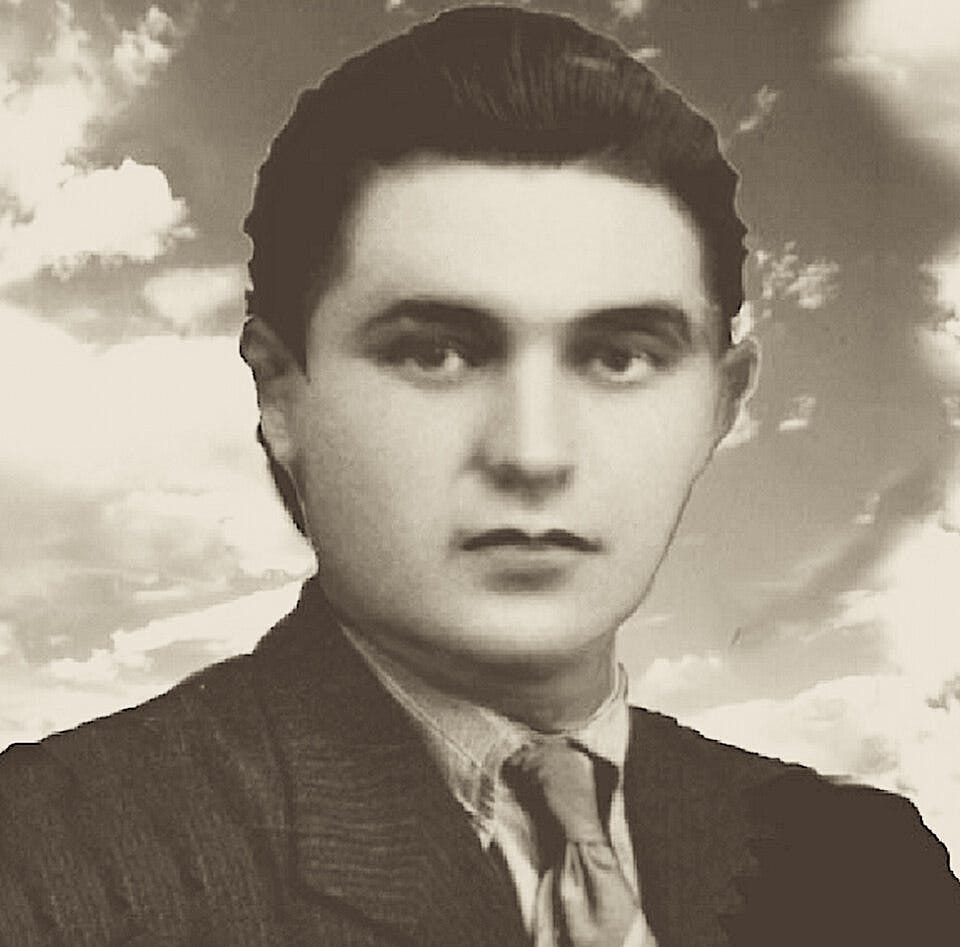
By My Good Name
An Elias Thorne origin story

In response to Ian Patterson’s The Thousand Faces of Elias Thorne prompt.
It is true that I was born into a mostly drunken Irish tribe in Tuatha and am therefore a Tuathan. Or was.
The cattle went missing on a Tuesday. I remember the sky that day was a fiendish, unspeakable violet. The tribal elders gathered with long faces. They produced a boy who pointed at me with accusation. I don’t know why he pointed at me. I solemnly swear I have never once in my life desired a cow. The allegation demonstrated a profound misunderstanding of my tastes.
The elders called it theft. I called it a misplacement of colossal proportions. But the tribunal did not care for the distinction. They stripped me of my name, my hearth-right, and my seat by the fire where the old stories were told in voices low and trembling. I walked out past the huddled families at dusk, and I did not look back, because looking back seemed like the sort of thing that invited further scrutiny.
I carried nothing but the unshakable belief that the universe had singled me out for something enormous and cruel. I encountered a brigantine called the Shiny Clam and boarded as a deckhand with complete disregard for destination. I did not know where else to go or what to do, but I felt a swelling certainty that I was destined for something in the world bigger than the Tuatha and all of its cattle.
I arrived in Madagascar with the name Elias Thorne, assigned to me at random by Captain Edward Scrote after a single stroke through his haphazard beard. The port officials were accepting, but they were firm: no expatriate could remain without property. I had never wanted to own anything in my life. Ownership seemed to me a devilish trap, a thing that tethered a man to the earth. But I had nowhere else that was calling to me, so I complied.
The only apparent property for sale in Madagascar was the communal latrine at the edge of the Bemoky village, which in this case was a reeking, squamous structure that the locals regarded with a kind of weary reverence, as though it were older than the village itself. I bought it for almost nothing from what one might call a desperate seller. Though not particularly proud of the fact, I had instantly become a real estate mogul.
I slept on a pallet behind the latrine. The nights were thick with a heat that seemed to have its own philosophy. I would lie awake and listen to the business of the latrine as it proceeded with agreeable regularity, and I would think: this is what the tribunal in Tuatha has made of me. I am a foreign landowner, a man of property. But I did not complain because complaining seemed beneath a man, even a scourge who had once been accused of stealing cattle.
The Bemoky villagers began to offer small nods to me in the mornings. I took this as a sign of tremendous progress. But then came the new war to turn everything upside down.
I volunteered to fight in the Copper Wars because a man of property should also be a man of principle. By my mother’s eyes, this was the only reason I joined. The recruiters did not ask questions about the latrine being my primary address, and after a cursory head-to-toe glance, they saw me fit for Madagascarian infantry.
They sent me to the Antarctic theater, which I had not known existed until I was standing in it. The cold there was more of a perpetrator than a temperature. It had opinions about a man’s smallness, which was an area of self-assessment where I needed no assistance.
I served in the army well enough, I suppose. I marched and I dug. I fired my rifle at a whiteness that gave no indication it had been struck. During a most abhorrent skirmish with zero visibility, I managed to lose my unit. I ran in a direction I believed was forward. Alas, it was only forward to me. The wind erased the tracks behind me as fast as I made them, as though the continent itself wished no record of my passing.
I walked for what may have been days. The horizon bent with impossible geometry. I came upon a plateau I did not recognize from any map issued by the Madagascarian army. It was a vast and imposing shelf of stone and ice, and against my better judgment I climbed it with the patience of a debt collector.
I believe now that this was the fabled Plateau of Leng, mentioned in the dreaded books of old I read as a child. I had no compass, no maps, and by that point, precious little confidence in my own abilities. I only know that something was up there with me, and it gave me a great sense of unease and regret for not having stayed below.
Weeks passed on that plateau, or perhaps it was days that only felt like weeks, time having become a thoroughly dishonest companion. I do not remember all of it, as if some part of me is protecting the other parts. I promise to the Lord this is not some form of evasion. Some contents of my mind simply refuse to organize.
I was found wandering by a group of soldiers from Siam. I was muttering, I am told, mad phrases about Old Ones. These beings I babbled about, if they are truly beings, must have been as utterly indifferent to the Copper Wars as they were to a Tuathan cattle heist. I do not recall the muttering that has been attributed to me. I only recall waking to find myself surrounded by unfamiliar uniforms and a terse but incomprehensible language.
The Siamese did not treat me unkindly, but they did not trust me either. I could scarcely blame them. A man raving of ancient horrors is not, I gather, a comforting prisoner. They took me for a POW, even though I had fought for no side they recognized, and they locked me in the medical hold of their icebreaker ship. And though at no time was I actually suffering from an illness (a point I insisted on often), I was cared for as such.
The hold smelled of iodine and salt. I lay on a cot bolted to the floor and listened to the hull groan against the ice, a monstrous creaking, as though the ship itself was belching something it had eaten long ago. I had been a landowner and a soldier, but now I was simply captive cargo.
I remained in that hold for months as others came and went. The war raged somewhere beyond our location, indifferent to my confinement. I was fed and watched. I was, I attest on my good name, never once ill, though I continued to have my vitals checked as if I were a patient of quite some importance.
It was there in the medical hold I met my husband and fellow POW, Rolf. He had been, to my astonishment, the skeeball champion of Tannu Tuva, a title he wore with a solemnity I found absurd at first, but later strangely comforting. In a world gone seemingly mad, here at last was a man who cared, inexorably and completely, about the trajectory of a small wooden ball.
We married in the center of the hold, witnessed by a Siam officer who seemed more whimsical than official. It was the happiest I had been since my last day’s memory of the horrid sky slouching over Tuatha.
But my husband carried his own tribunal. Before the war, Rolf had accidentally drowned a competitor in the championship waters of Tannu Tuva, convinced, perhaps rightly, that the man was high-arcing—a despicable and illegal technique in every athlete’s book. He was declared damnatio memoriae for the killing and his name was erased from every record for committing a sin his country could not find a way to forgive. Rolf did not speak of it or the accidental drowning, and I hesitated to ask for a meaningful clarification, but there was a moment once as we leaned together over th edge of a wishing well where Rolf had a mild breakdown regarding my suggestion we toss pennies at the same time.
We assumed the war had ended because the ship docked in the Virgin Islands while the sailors arranged festivities throughout the wings, decks, and gangways. For one week Rolf and I were simply a married couple, ordinary and unremarkable, walking a shore the color of nothing and somewhat feeling as if we were on honeymoon. We decided to go parasailing, as appeared to be the local custom. But mere hours after repeating “To have and to hold” in unpracticed monotone, Rolf’s rope popped free with the sound of a pistol shot and he sailed a majestic beeline toward the other side of the island. Recovery efforts lasted for only three days, while I was subjected to humiliating questions such as “Were you two having trouble?” and “Did you suspect there was someone else?” from cigar puffing investigators. My poor Rolf was never seen again.
After my husband vanished into that decrepit sky over the Virgin Islands, I did not know what to do next with my pathetic little life and newly developed fear of heights. With my grandmother’s ghost as my witness, I searched for guidance and found none. I had grown accustomed to the gods declining to explain theirselves in worldly matters, but this silence was of a different, more strangling order.
So I went to Alabama.
I do not know why Alabama, except that it was very far from ice and skeeball and anything that might cause a man to vanish or become banished. I joined a monastery that squatted in a dry brick building with a ghoulish devotion to quiet. The monks did not ask about the Tuathan tribunal, Madagascar latrines, mysterious plateaus deep in the tundra, or fake illnesses while aboard a Siamese icebreaker. They asked only that I rise at four and sweep the halls, which I did, gratefully, as though sweeping might finally sweep some meaning into my life.
I stayed a long while, growing devastatingly still the way a pond goes mirror-like once nothing more is thrown into it. But eventually the stillness itself began to feel like a kind of whispering demon. So, I left the nameless monastery with a handful of tourist currency left over from that tragic island kiosk along with a powerful but unreasonable inclination to again become a property owner.
I discovered a failing salmon farm a mere twenty miles north that sat sagging and half-drowned in its own neglect. It was for sale outside of an oblivious town, and I bought it for a handshake and a few American dollars. I do not know why salmon, except there we both were, the fish and I.
The salmon farm took root in a modest and unspectacular way, and I began to feel something I had not felt since before the cattle went missing: the haunting, unfamiliar sensation of things going right.
It was this confidence, I believe, that led me to run for Constable of the local precinct. Right hand to Father Time, I had no ambitions as grand as those of, say, Captain Scrote, whose legendary schemes, I later learned, included stealing the Canadian military’s only armored tank. I only wished, after Tuatha and Madagascar and Leng and the ice and the sea that took my husband, to hold some small and legitimate office in a town that did not know my history and did not ask.
The campaign went well enough. I shook liver-spotted hands and pinched the children’s cheeks. I gave a speech about civic order that I do not remember writing. Then, three days before the vote, I was disqualified.
The reason given was archaic, vague, and, as far as I could determine, pertained somehow to the fish themselves. No official could explain it clearly, and I eventually reckoned it a matter of local superstition I was not meant to comprehend. I have long since stopped expecting the universe to show its work for any of the math involved.
But I think the town felt sorry for me. Word of the disqualification spread, and with it, my name—Elias Thorne—mattered. It attached, for once, to nothing worse than an old fish law and a farm coming back from ruin. Verily, my salmon sales rose accordingly.
And all things considered, it was more than I had any right to expect.